
Jev 1.13
Live model card, aliases, price, and limits.
The live model is Jev 1.13 with versioned ID jev-1.13.0. Every model on TypeSafe's card is served by POST /v1/systemone; the request's model field selects which name handles the call. jev-latest is the SDK default and currently resolves to jev-1.13.0. jev-preview currently points at the same ID; TypeSafe says no preview build is available. Pin the versioned ID if you have tuned thresholds against this card.
Price, context, and rate limits
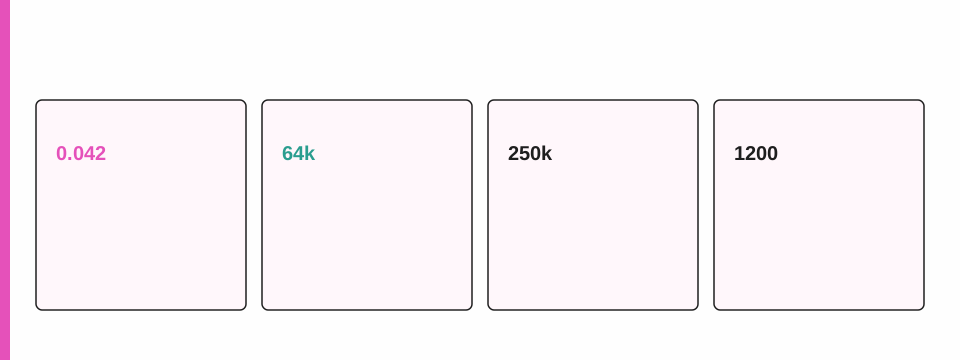
Input is $42 per billion tokens, which is $0.042 per million. Output tokens are free. A request over the documented 250,000 tokens per second or 1,200 requests per minute returns 429 Too Many Requests. Official SDKs retry with backoff and honor retry-after when present. TypeSafe warns that limits are adjusting dynamically while demand is high and GPU deals land, and that they can change without notice. Custom and enterprise plans can raise the cap through sales@typesafe.ai.
Context is 64k tokens per request. A second budget of 32k tokens applies to state plus the longest question. Jev ingests state once and evaluates every question against it in parallel, so the 64k window covers state plus all questions combined. As state grows with unrelated detail, accuracy drops — that failure mode is listed on the jaggedness page. Pack many small questions with speculative fan-out rather than stuffing the whole warehouse into one field.
Input is text only: a string, a JSON object, or an array of text values. No image, audio, or video input. Preprocess non-text into fields before you call. English is the primary training language. Other languages, including CJK, are handled with lower accuracy, so measure confidence before you automate a non-English queue.
Jev 1.13
- modelId
- jev-1.13.0
- role
- versioned-id
- pricePerMillionInputUsd
- 0.042
- outputBilled
- false
- tokensPerSecond
- 250000
- requestsPerMinute
- 1200
- contextTokens
- 64000
- statePlusLongestQuestionTokens
- 32000
- input
- text-only
jev-latest
- modelId
- jev-latest
- role
- stable-alias
- pointsTo
- jev-1.13.0
- sdkDefault
- true
jev-preview
- modelId
- jev-preview
- role
- preview-alias
- pointsTo
- jev-1.13.0
- previewBuildAvailable
- false
Aliases and listing models
An alias is a model name that resolves to a versioned ID. Send it in the model field like any other name. jev-latest means the most recent stable official release. jev-preview means the most recent release whether or not it is official, and it moves ahead of jev-latest when a preview build exists. Right now both names point at jev-1.13.0.
An alias moves when a new release ships, so answers behind it can change without a code change on your side. The response's model field reports the versioned ID that answered. Log that ID. If confidence thresholds were tuned on jev-1.13.0, keep sending jev-1.13.0 until you re-tune.
GET /v1/models returns the names your account can send, with a description and release date. It currently lists the aliases. Versioned IDs such as jev-1.13.0 are accepted in the model field whether or not they appear in that list.
Data handling and customization
Jev is not fine-tuned or LoRA-adapted with customer data. It is not trained on customer requests or responses. The same RLCD weights serve every account. You specialize through state content, instructions, criteria, and composition in code. TypeSafe's legal index covers the DPA, privacy policy, and zero data retention for enterprise customers.
End-to-end response time is stated as 70ms-500ms, with most queries around 100ms. That range is a published claim from the launch materials, not a latency SLO in this wiki's own measurements. Pair it with the rate-limit note: throughput and RPM can move while TypeSafe scales early access.
Which name to send in production
Send jev-1.13.0 when the gates you tuned last week must still mean the same thing next week. Send jev-latest when you want TypeSafe's current official release and you will re-read confidence histograms after each alias move. Send jev-preview only if you are ready for a non-official build; today it is the same pointer as jev-latest.
Log response.model on every call. That field is the versioned ID that actually answered, even if you sent an alias. Join it to requestId when you debug a 429 or a surprising Noul. GET /v1/models will not always list jev-1.13.0 even though the endpoint accepts it.
Price the input side only. Output tokens are free, so fan-out is cheap relative to a chat model that bills completion. A 10 query/second Doom-style loop at $0.042/MTok is the launch illustration of that economics. Still respect 1,200 RPM and 250,000 tokens per second, and expect those numbers to move without notice during early access.
When sales quotes a custom limit, that number is not on this card until TypeSafe publishes it on docs.typesafe.ai/models. Until then the public figures are 250,000 tokens per second and 1,200 requests per minute, with the explicit warning that they can change without notice. Enterprise zero data retention is a legal-index topic, not a model-card toggle.
English remains the strongest language on this card. If you serve CJK tickets, keep confidence gates tighter and sample your own queue before you remove humans. The model will accept the characters; the accuracy note is the reason to measure, not a hidden 403.
Alias movement is a release event. Read the models page again when TypeSafe ships a new versioned ID, then decide whether your gates still hold. The card on this page is Jev 1.13, not a promise about 1.14.
Output tokens stay free on this card. That is why packing extra questions is usually cheaper than a second generative call.
Sources